

Intelligent Intermodal Routing for Resilient Door-to-Door Transport Planning
Intermodal routing · Disruption resilience · Collaborative logistics
Introduction
Composing efficient door-to-door transport chains is a complex and time-consuming planning task, particularly when multiple transport modes and operational constraints must be considered. The intermodal routing service addresses this challenge by automatically calculating and visualizing feasible transport chain compositions across different modes of transport. By integrating routing intelligence, network data, and operational parameters, the service enables planners and logistics stakeholders to quickly identify and compare alternative transport options. This reduces manual planning effort, improves transparency in decision-making, and supports the development of more efficient and sustainable logistics operations. The service is designed to facilitate intermodal transport planning by providing reliable, data-driven route alternatives tailored to specific transport requirements.Why it is important for logistics / multimodal transport / resilience
In case a disruption, be it local isolated or one of networkwide impact, transport chains suffer from this event. In some cases, the transport chain gets delayed, in some other cases the transport chain may completely break. The tool support provides at any time decision support for strategic, tactical and operational planning and replanning.
PTV’s contribution to ReMuNet
Within ReMuNet, PTV contributed advanced routing, planning, and simulation software services that serve as core components of the platform and its connected services. By providing state-of-the-art transport modelling and optimisation capabilities, PTV enables the calculation, evaluation, and visualization of efficient multimodal transport solutions. These services support data-driven decision-making, improve operational planning processes, and enhance the overall functionality of the ReMuNet Platform. PTV’s contribution ensures reliable integration of routing intelligence and simulation capabilities, helping stakeholders assess transport alternatives, optimize logistics operations, and support more sustainable and resilient supply chains.
The broader impact or relevance of the result
The developed service set enables collaboration between multiple stakeholders by supporting the shared use of transport capacities and coordinated planning processes. This is particularly valuable in situations involving network disruptions or high-demand events, where collaborative decision-making can help maintain efficient and resilient transport operations. By facilitating capacity sharing and providing transparent routing alternatives, the solution strengthens cooperation across supply chain actors and improves overall network utilization. In addition, the platform supports the optimisation of low-emission transport chains while taking into account detected or simulated disruption impacts. This contributes to more sustainable, adaptable, and resilient logistics operations, supporting both environmental objectives and operational continuity across multimodal transport networks.Describe the operational/ technological/ research context in which this work was developed.
About PTV Group
PTV Group is a leading provider of software solutions for transport planning, traffic management, and logistics optimisation. Within the ReMuNet project, PTV acts as a technology and solution provider, contributing advanced routing, planning, and simulation services as key components of the platform. PTV’s role focuses on enabling efficient multimodal and intermodal transport planning through data-driven routing intelligence, transport network modelling, and disruption analysis. By integrating these capabilities into the ReMuNet Platform, PTV supports collaborative logistics operations, sustainable transport optimisation, and resilient supply chain management across different stakeholders and transport modes. PTV was WP lead for the algorithmic workpackage as well as it was involved in several other tasks.
Challenge
PTV addressed the challenge of enabling efficient and resilient multimodal transport planning in highly dynamic logistics environments. One of the key technical challenges was the integration of heterogeneous transport network data, routing services, and simulation capabilities into a scalable platform architecture capable of supporting real-time decision-making. In addition, operational barriers such as fragmented planning processes, limited transparency between stakeholders, and insufficient coordination across transport modes had to be considered.
Another important challenge involved handling disruptions and capacity constraints within transport networks while still providing reliable and feasible routing alternatives. Data availability and quality also represented significant limitations, particularly when combining information from different systems and stakeholders. From a sustainability perspective, the solution needed to support low-emission transport optimisation without compromising operational efficiency or resilience. PTV therefore focused on delivering intelligent routing and simulation services that enable collaborative planning, improve network adaptability, and support informed decision-making for all participating stakeholders.
Solution
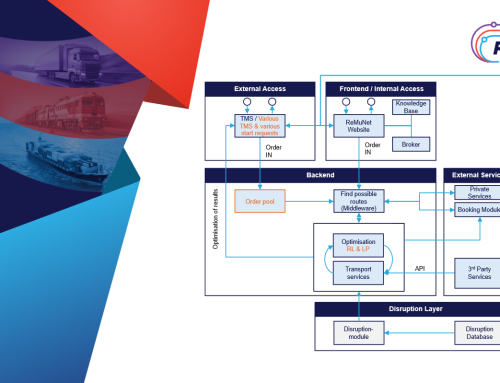
PTV developed advanced intermodal routing, planning, and simulation services as core components of the ReMuNet Platform. The solution enables the automatic calculation, evaluation, and visualization of feasible door-to-door transport chains across multiple transport modes, including road, rail, and inland waterways. The services are integrated into the platform architecture and provide users with intelligent routing capabilities that support collaborative and data-driven transport planning.
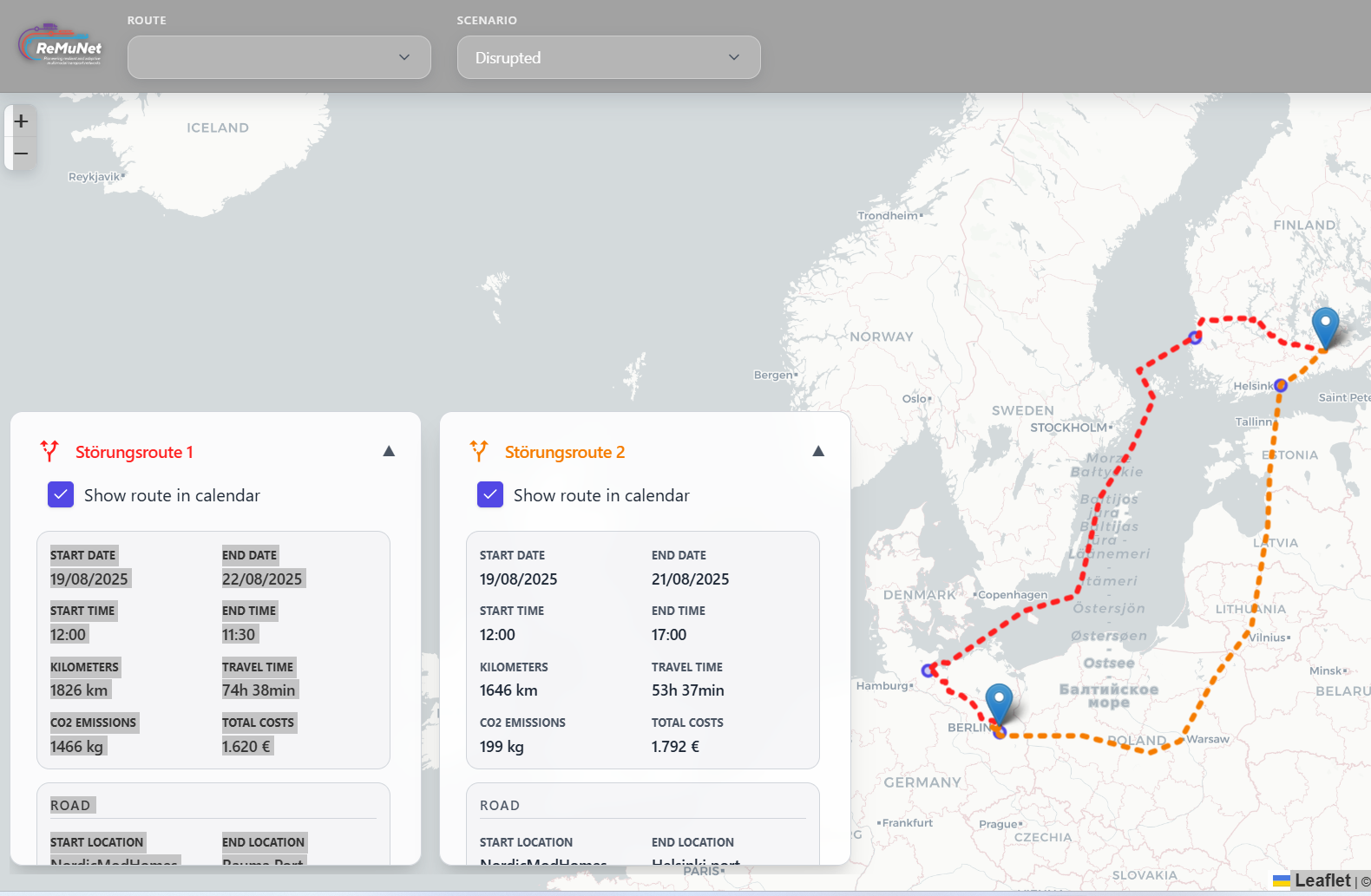
The solution works by combining transport network data, operational parameters, disruption information, and routing intelligence to generate and compare alternative transport chain compositions. The routing and simulation components can consider factors such as transport time, network capacity, emissions, costs, and disruption impacts. This allows stakeholders to assess different routing scenarios and identify resilient and sustainable transport alternatives under changing operational conditions.
The innovative aspect of the solution lies in its ability to integrate multimodal routing, disruption-aware planning, and collaborative logistics support within a unified digital platform environment. By linking routing intelligence with simulation and optimization capabilities, the service supports proactive decision-making and enables stakeholders to react more effectively to disruptions or capacity shortages. The platform also facilitates cooperation between different actors through shared visibility of transport options and capacity utilization.
The solution contributes to resilient multimodal transport of the REMUNET platform by improving flexibility, transparency, and adaptability across transport networks. It supports the optimization of low-emission transport chains while maintaining operational continuity in the presence of network disruptions or changing demand conditions. Through intelligent routing and simulation services, end-users are able to evaluate alternative transport strategies, improve resource utilization, reduce planning effort, and make more informed operational decisions
Outcome & Next steps
The developed routing, planning, and simulation services were successfully integrated into the ReMuNet Platform, demonstrating their ability to support collaborative and resilient multimodal transport planning. The solution improved operational decision-making by enabling stakeholders to automatically generate, evaluate, and compare alternative transport chains under normal and disrupted network conditions. The integration of disruption-aware routing and simulation capabilities increased transport network resilience while supporting low-emission and resource-efficient logistics operations. The platform also enhanced collaboration between different actors through improved transparency and shared access to transport planning information.
The demonstrations validated the feasibility and scalability of the approach within a collaborative digital platform environment. Lessons learned highlighted the importance of interoperable data exchange, integrated routing intelligence, and cross-stakeholder coordination. Future developments will focus on extending platform functionalities, improving real-time data integration, and supporting broader implementation and exploitation opportunities for resilient and sustainable multimodal transport planning.Contact
Name Position Organisation Email Florian Krietsch Senior Project Manager PTV [email protected]
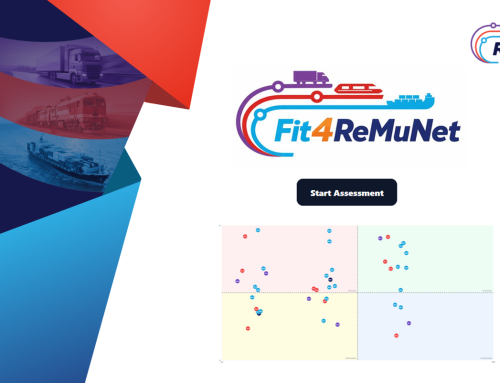
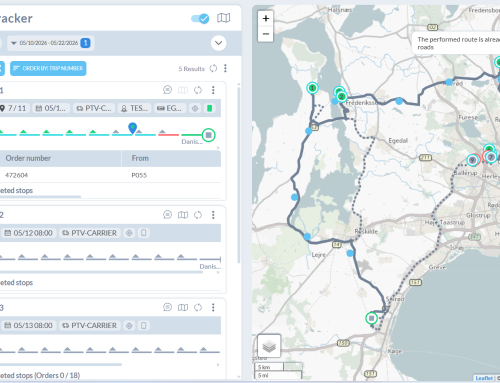
Real-Time Visibility Across Multimodal Transport Chains
Enables continuous monitoring of shipments and transport conditions to improve transparency and coordination across road-based multimodal freight operations.
Predictive ETA and Disruption Monitoring for Operational Resilience
Combines real-time telematics and analytics to detect deviations, forecast arrival times, and support faster response to transport disruptions.
From Fragmented Data to a Unified Operational Transport View
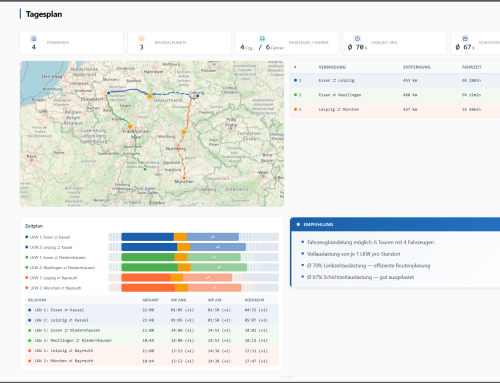
Integrates heterogeneous logistics and vehicle data sources into a single shared interface, supporting data-driven decisions and more efficient transport execution.
 Funded by the European Union under GA number 101104072. Views and opinions expressed are however those of the author(s) only and do not necessarily reflect those of the European Union or the European Climate, Infrastructure and Environment Executive Agency (CINEA). Neither the European Union nor the granting authority can be held responsible for them.