

ReMuNet Platform Ecosystem Design for Resilient Multimodal Freight Transport
Platform architecture · Ecosystem design · Sustainable business models
Introduction
European freight transport relies on the interaction of many actors across road, rail, inland waterways and short sea shipping. Yet in practice, multimodal transport is still shaped by fragmented information, limited interoperability and complex coordination between organisations. These challenges become especially visible during disruptions, when logistics actors need fast access to reliable information about affected routes, available capacities and feasible alternatives.
ReMuNet addresses this challenge by developing a collaborative digital platform for resilient and sustainable multimodal freight transport. The platform is designed to support disruption-aware route planning, capacity optimisation and better coordination between key logistics actors. However, such a platform can only create practical value if it is embedded in a functioning ecosystem. This requires a clear platform architecture, a shared understanding of actor roles and a sustainable logic for value creation.
D3.2 brings these elements together. It defines how the platform can operate as a central information and coordination hub and how different stakeholders can participate in and benefit from a more resilient multimodal transport network.
- Context
Disruptions in multimodal freight transport rarely affect only one actor. A delay at a terminal, a blocked rail section, an unavailable inland waterway connection or a road disruption can quickly influence several transport legs, organisations and planning systems. Today, relevant information is often distributed across separate IT systems and actor-specific processes. This makes it difficult to create a shared situational picture and to identify reliable alternatives across transport modes.
At the same time, the transition towards more sustainable freight transport requires stronger collaboration. Multimodal solutions can reduce emissions and increase network efficiency, but they depend on transparency, trust and digital connectivity. Actors need to know which transport options are available, how disruptions affect planned routes and how alternative modes or capacities can be used.
The ReMuNet platform ecosystem responds to this need by combining technological architecture with ecosystem design. It shows how data, services and actors can be connected in a structured way so that ReMuNet can support operational decision-making, disruption response and sustainable business models.
- FIR an der RWTH Aachen’s contribution to ReMuNet
Within ReMuNet, FIR an der RWTH Aachen contributed to the design of the platform ecosystem and the underlying platform architecture. The work builds on the analysis of the current multimodal transport ecosystem and translates stakeholder needs, pain points and platform requirements into a future-oriented concept.
FIR’s contribution combines three perspectives. First, it defines the main functional layers of the ReMuNet platform architecture. Second, it maps the future ReMuNet ecosystem, including key actor roles, user needs and value flows. Third, it analyses how ReMuNet can influence sustainable business models and collaboration between actors. In this way, the result links technical platform development with the organisational and business logic needed for real-world adoption.
- About FIR an der RWTH Aachen
FIR an der RWTH Aachen is a research institute based in Aachen, Germany. The institute engages in various research topics promoting upgrade circular economy and developing future prove logistics and ecosystem concepts. As project coordinator and research entity, FIR an der RWTH Aachen is responsible for the project governance and development of the ReMuNet ecosystem including its platform, business model and transformation methodology.
- The challenge
The key challenge was to design ReMuNet not only as a technical platform, but as a collaborative ecosystem. The multimodal freight transport sector includes many different actors, such as infrastructure operators and managers, carriers, multimodal transport operators, terminal operators, freight forwarders, software providers, digital logistics service providers, consignors, consignees and governmental entities. These actors have different responsibilities, data sources, business interests and levels of digital maturity.
For ReMuNet to work in practice, the platform must support this diversity. It needs to connect existing systems, integrate external data sources, process disruption information and provide useful decision support without replacing the operational roles of established actors. It must also create clear value for participants. Stakeholders need to understand how they benefit from sharing information, using platform services and participating in a more coordinated multimodal ecosystem.
This required a combined approach: a platform architecture that explains how ReMuNet works technically, and an ecosystem design that explains how the platform creates value between actors.
- The solution
The ReMuNet Platform Ecosystem Design defines ReMuNet as a central digital hub for disruption-aware multimodal transport planning and coordination. It describes a target architecture for a market-ready solution and was not implemented as part of the demonstrator developed within the project.
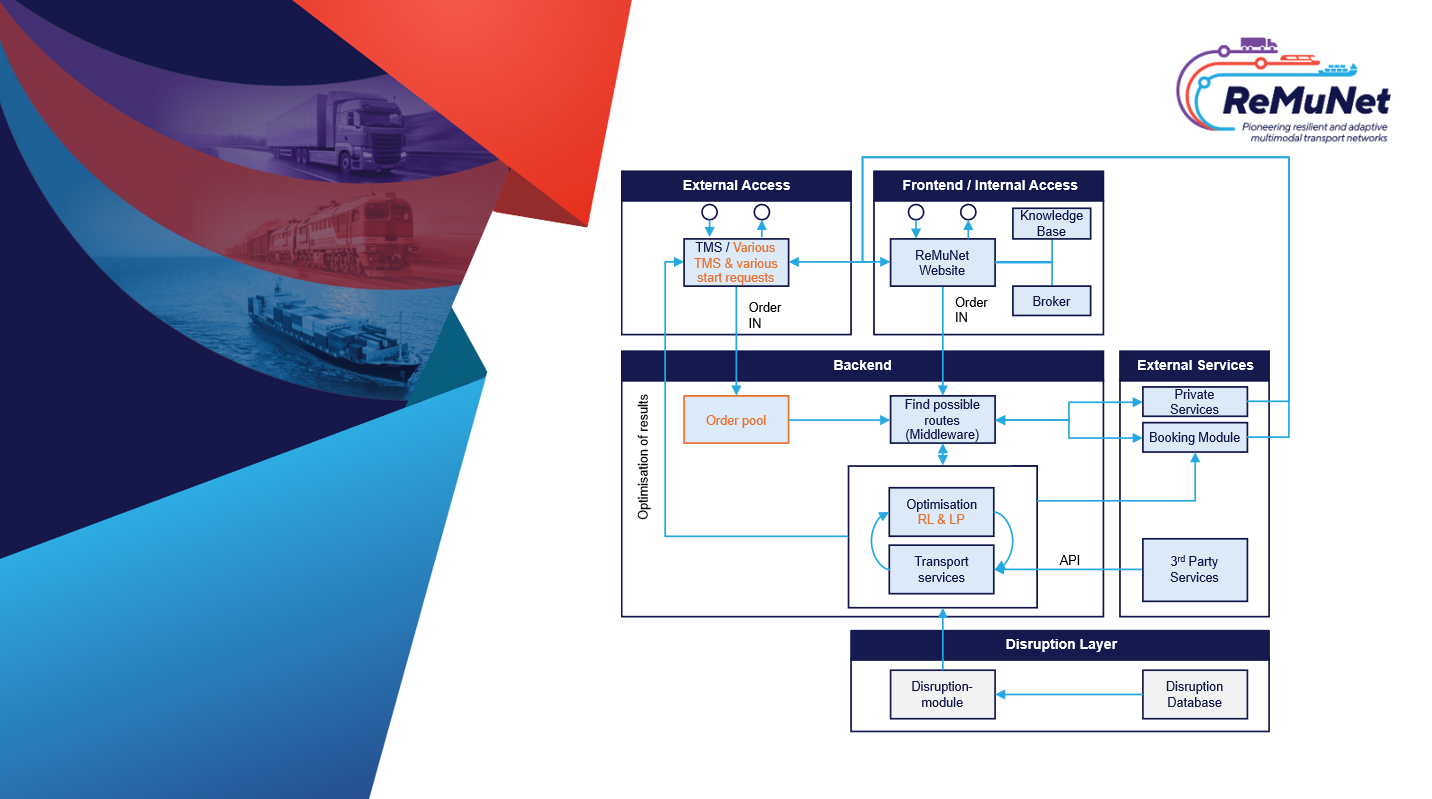
From a technical perspective, the platform architecture consists of several connected layers. External access links ReMuNet with existing systems such as transport management systems and third-party logistics platforms. A frontend layer gives users access to platform functions through a web-based interface. The backend forms the core of the platform, where orders are processed, routing options are identified and optimisation logic is applied. External services provide additional data and functionality, for example regarding transport networks, routing, capacities or environmental information. A dedicated disruption layer integrates disruption-related data and feeds it into the planning and optimisation process.
A central element of the architecture is the distinction between relation-based and network-based optimisation. The relation-based approach supports the optimisation of individual transport relations, for example by comparing options based on time, cost, emissions or arrival reliability. The network-based approach goes further by considering multiple transport orders and available capacities together. This enables ReMuNet to support broader network optimisation and more resilient responses during disruptive events.
From an ecosystem perspective, ReMuNet strengthens the flow of information between actors. The physical transport of goods remains in the hands of logistics operators, carriers, terminals and infrastructure actors. ReMuNet adds value by improving transparency, connecting relevant data and supporting coordinated decision-making. The platform can provide disruption alerts, alternative routing options, capacity-related information, sustainability indicators and updated planning information.
The ecosystem design also clarifies how different actors can benefit. Infrastructure operators and managers gain better visibility of network conditions and disruptions. Carriers can improve operational response and route planning. Multimodal transport operators can coordinate transport chains more effectively. Terminal operators can benefit from better planning information and utilisation forecasts. Freight forwarders can offer more resilient and sustainable transport services. Software providers and digital logistics service providers can integrate ReMuNet-related services into their own solutions.
In this way, ReMuNet is designed not only as a software solution, but as a collaborative platform ecosystem that supports resilient multimodal freight transport.
- Key results and outcomes
The result delivers three main outcomes.
First, it provides a structured platform architecture for ReMuNet. This architecture explains how external systems, user interfaces, backend components, external services and disruption-related data can interact to support multimodal transport planning and optimisation.
Second, it defines ReMuNet’s role in the future multimodal freight transport ecosystem. The platform is positioned as an information and coordination hub that complements existing actors and improves the exchange of data across organisational and modal boundaries.
Third, it identifies role-specific value creation opportunities and implications for sustainable business models. The ecosystem design shows how different stakeholders can use ReMuNet to improve transparency, resilience, sustainability performance and operational decision-making.
Together, these outcomes help translate the ReMuNet vision into a practical platform ecosystem. They make clear that resilience in multimodal freight transport is not only a matter of better algorithms or more data. It also depends on collaboration, trust, clear roles and business models that make participation attractive for different actors.
Context
Name Position Organisation E-mail Maximilian Dicks Project Coordinator and Group Leader Smart Mobility FIR an der RWTH Aachen [email protected]
Platform ecosystem
Defines ReMuNet as a collaborative hub connecting logistics actors, data, and digital services to strengthen multimodal transport resilience.
Platform architecture
Establishes the technical framework linking routing, disruption intelligence, optimisation, and external systems into one integrated platform.
Business value
Creates clear value for stakeholders through improved collaboration, data sharing, and sustainable business models for resilient freight transport.
 Funded by the European Union under GA number 101104072. Views and opinions expressed are however those of the author(s) only and do not necessarily reflect those of the European Union or the European Climate, Infrastructure and Environment Executive Agency (CINEA). Neither the European Union nor the granting authority can be held responsible for them.