

ReMuNet Platform Ecosystem Design for Resilient Multimodal Freight Transport
Readiness assessment · Platform transformation · Multimodal resilience
Introduction
A digital platform can provide disruption alerts, alternative routing options, capacity information and decision support, but its impact depends on whether logistics actors are ready to participate in a collaborative digital ecosystem. For many companies, especially those working across fragmented transport chains, the challenge is not only to connect to a platform but to adapt internal processes, data practices, organisational responsibilities and collaborative routines.
This is particularly important for ReMuNet as digital and collaborative platform to strengthen the efficiency, sustainability and resilience of European multimodal freight transport networks against disruptive events. To make such a platform useful in practice, multimodal freight transport actors need a clear understanding of what capabilities are required from them — and where they may need to improve.
Fit4ReMuNet addresses this transformation challenge. It provides a structured methodology and readiness assessment tool that helps logistics organisations understand their current maturity, identify capability gaps and receive practical guidance for participating effectively in the ReMuNet platform ecosystem.
FIR an der RWTH Aachen’s contribution to ReMuNet
Within Work Package 3 and Task 3.4, FIR an der RWTH Aachen developed the Fit4ReMuNet transformation methodology. The work builds on previous ReMuNet deliverables covering the multimodal freight transport ecosystem, the platform architecture, the business model and the operator model. It also draws on established transformation frameworks, including the Industrie 4.0 maturity index and the Business Transformation Canvas.
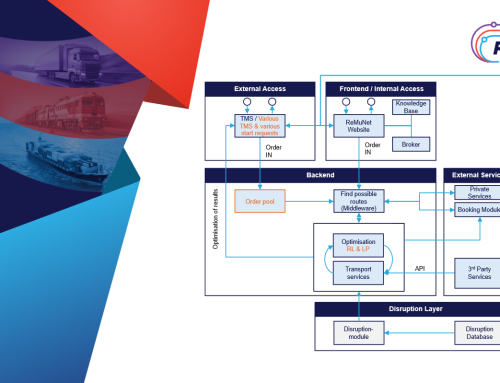
The result translates ReMuNet’s platform concept into a practical organisational preparation framework. Rather than focusing only on technical integration, Fit4ReMuNet looks at the business capabilities that organisations need to use, provide or support platform services. It therefore complements the ReMuNet platform architecture by addressing the human, technological and organisational conditions required for adoption.
The methodology was developed around four platform user types: service users, service providers, data providers and capacity providers. Because one organisation may take on more than one role, the assessment is designed to be role-specific.
About FIR an der RWTH Aachen and role in ReMuNet
FIR an der RWTH Aachen is a research institute based in Aachen, Germany. The institute engages in various research topics promoting upgrade circular economy and developing future prove logistics and ecosystem concepts. As project coordinator and research entity, FIR an der RWTH Aachen is responsible for the project governance and development of the ReMuNet ecosystem including its platform, business model and transformation methodology.
The challenge
The ReMuNet platform depends on collaboration between different actors across road, rail, inland waterways and short sea shipping. These actors differ significantly in their digital maturity, operational responsibilities, data quality, IT infrastructure, strategic priorities and willingness to share information.
Several barriers can limit effective participation. Data may be incomplete, inconsistent or difficult to exchange. Processes may still be manual or only partly standardised. Responsibilities for disruption response may be fragmented across departments. Some organisations may lack clear internal alignment on how a platform-based approach supports their business. Others may have the technical ability to connect but lack the organisational routines needed for collaboration, data governance or resilience-oriented decision-making.
This creates a practical adoption gap. ReMuNet can offer route optimisation, disruption management and collaborative planning functionality, but companies also need to know whether they are ready to use these functions effectively. Fit4ReMuNet addresses this gap by turning platform participation into an assessable and actionable transformation roadmap.
- The solution
Fit4ReMuNet is built around a ReMuNet business capability map. The map structures the capabilities needed for effective platform participation into four areas: meta capabilities, human-centred capabilities, technological capabilities and organisational capabilities.
The meta capabilities cover sensing, seizing and transforming. These describe an organisation’s ability to recognise changes in its environment, act on opportunities and adapt over time. Human-centred capabilities include strategic direction, collaboration mindset, change management and digital literacy. Technological capabilities cover digital infrastructure, data security, interoperability, platform utilisation, data quality and automation. Organisational capabilities include sustainability, regulatory and risk management, operational knowledge, holistic value logic and organisational resilience.
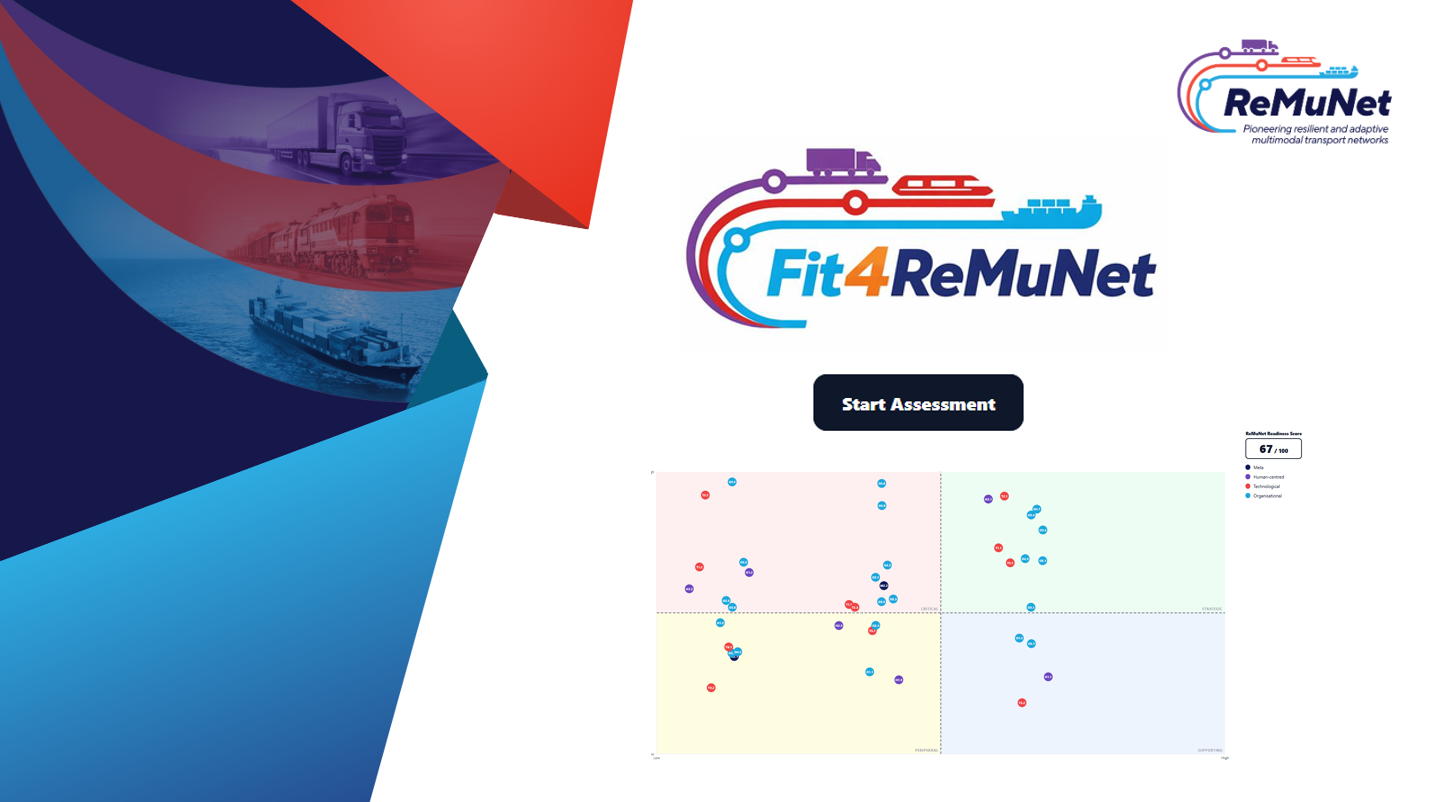
The online readiness assessment translates the capability map into a structured tool for evaluating organisational readiness to participate in ReMuNet. It first distinguishes the organisation’s intended role in the ecosystem — data provider, service provider, service user or capacity provider — and then narrows the assessment to the capabilities that are relevant for that role. Organisations rate their maturity for each capability on a three-level scale from low to high readiness. These maturity levels are then interpreted together with the relevance of each capability for ReMuNet participation. The result is a role-specific overview of strengths and readiness gaps, helping organisations understand where they are prepared to engage with ReMuNet and where further development, support or capacity building is required.
The output is a readiness matrix that positions capability characteristics according to readiness and relevance. These are grouped into four sectors: critical, peripheral, strategic and supporting. This makes the assessment immediately usable: organisations can see where high relevance meets low readiness and where improvement efforts should be prioritised.
- Key results and outcomes
Fit4ReMuNet delivers three main outcomes for ReMuNet and its stakeholders.
First, it provides a ReMuNet-specific business capability map. This creates a shared language for discussing what organisations need in order to participate in a collaborative multimodal freight platform. It also connects platform participation to concrete business areas such as data exchange, platform utilisation, operational resilience and sustainability performance.
Second, it introduces role-specific readiness assessment. A service user, for example, needs capabilities that support the integration of standardised processes and the use of platform outputs for planning and optimisation. A data provider must focus more strongly on standardised formats, data quality and the topicality of shared information. Capacity providers play a direct role in network resilience by making capacity visible and bookable, enabling disrupted transport orders to be rescheduled more quickly.
Third, the methodology produces practical transformation guidance. Instead of presenting a static score only, Fit4ReMuNet links assessment results to improvement measures. The transformation roadmap groups capabilities by priority and provides recommendations for developing them. The ReMuNet Readiness Score offers an overall orientation value, but it is not designed as an exclusion criterion for platform participation.
The methodology is also clear about its limitations. The current three-level maturity scale is intentionally accessible, but future development could make the assessment more detailed. The report also identifies potential improvements, including company size-dependent assessments, the inclusion of transformation effort as an additional prioritisation variable, further development of the readiness score and practical validation of the guidance through real participation in the ReMuNet ecosystem.
- Next Steps
The next step is to strengthen Fit4ReMuNet as a practical adoption support tool for the ReMuNet platform. Future development could refine the maturity model, adapt assessment pathways to different company sizes and add transformation effort as a third dimension alongside readiness and relevance. The online tool could also be expanded to provide more tailored guidance, stage-dependent recommendations and clearer interpretation of the ReMuNet Readiness Score.
Fit4ReMuNet is not a gatekeeping instrument. Its value lies in helping organisations understand how they can prepare for platform-based multimodal transport and how their own capabilities contribute to a more resilient, efficient and sustainable freight network.
Context
Name Position Organisation E-mail Maximilian Dicks Project Coordinator and Group Leader Smart Mobility FIR an der RWTH Aachen [email protected]
Readiness assessment
Helps organisations evaluate their digital and organisational maturity for participating in the ReMuNet platform ecosystem.
Transformation roadmap
Provides practical guidance to identify capability gaps and prioritise improvements for successful platform adoption.
Collaborative adoption
Supports logistics stakeholders in building the skills, processes, and data practices needed for resilient multimodal collaboration.
 Funded by the European Union under GA number 101104072. Views and opinions expressed are however those of the author(s) only and do not necessarily reflect those of the European Union or the European Climate, Infrastructure and Environment Executive Agency (CINEA). Neither the European Union nor the granting authority can be held responsible for them.