

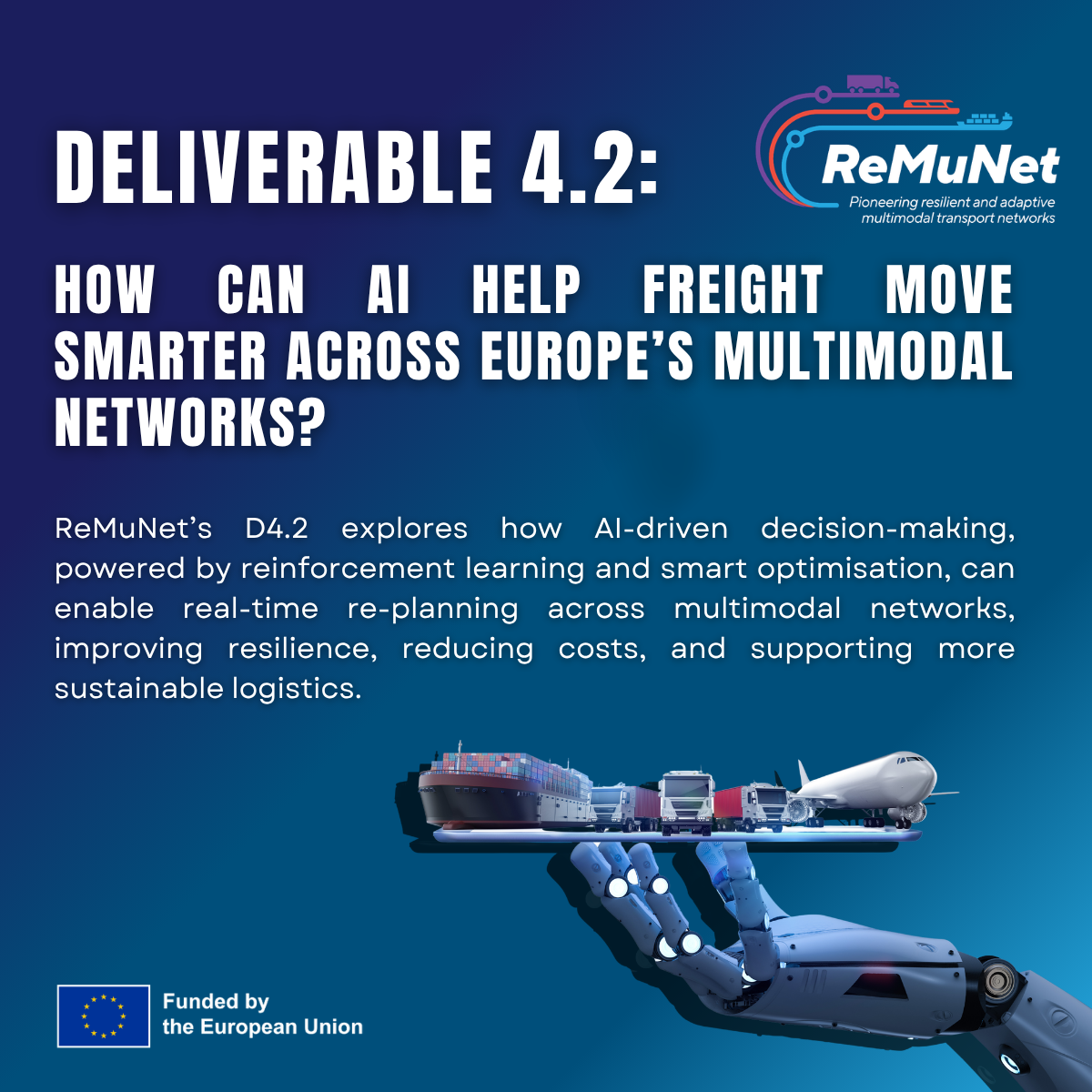
Deliverable 4.2, titled “Goal System, Objective Functions and KPIs,” was developed by Fraunhofer Austria as part of the ReMuNet project. The deliverable lays the conceptual and methodological foundation for how ReMuNet’s intelligent system will evaluate, optimise, and improve transport planning in complex multimodal networks. In particular, it defines the planning problem, optimisation objectives, and performance indicators that guide the development of ReMuNet’s AI-supported decision-making tools.
At the core of this work is the Synchromodal Transport Re-Planning Problem (STP), which represents the real-world challenge of managing freight transport across interconnected road, rail, and inland waterway networks. In practice, logistics systems are dynamic and unpredictable. Delays, disruptions, and operational changes frequently occur, making it necessary to adjust transport plans while goods are already in transit. D4.2 therefore focuses on how transport systems can adapt quickly and intelligently when disruptions occur, ensuring that shipments still reach their destinations efficiently and on time.
The deliverable describes a transport network consisting of terminals, routes, vehicles, and freight orders, all connected within a multimodal system. Each order has a planned route and schedule, but when unexpected events arise, such as delays, disturbances, or missed connections, the system must decide whether replanning is necessary and, if so, determine the best alternative route or transport option. This two-step process, first deciding whether to re-plan, and then how to re-plan, forms the operational backbone of ReMuNet’s decision-support framework.
A key innovation explored in this deliverable is the use of Reinforcement Learning (RL), a branch of artificial intelligence that enables systems to learn optimal strategies through experience. In this approach, an intelligent agent interacts with a simulated transport environment, continuously testing different decisions and learning from the results. Over time, the agent aims to improve its ability to select transport strategies that balance several objectives simultaneously, such as cost efficiency, delivery reliability, and environmental performance.
Rather than replacing existing logistics planning methods entirely, ReMuNet combines AI with established optimisation techniques. The RL system selects among a set of predefined planning heuristics, for example choosing the cheapest route, the earliest arrival option, or the path with the lowest emissions. By learning when to apply each strategy depending on the network conditions, the system can react dynamically to disruptions while maintaining reliable operations.
To measure performance and guide optimisation, D4.2 defines a comprehensive set of Key Performance Indicators (KPIs). These indicators evaluate the effectiveness of transport decisions based on criteria such as transport costs, delivery delays, feasibility of schedules, and CO₂ emissions. The system continuously tracks these metrics throughout the simulation, allowing it to assess how well different strategies perform and to adjust its decisions accordingly.
Beyond efficiency and cost reduction, the deliverable places strong emphasis on resilience and sustainability. Synchromodal transport, where freight can shift dynamically between modes such as road, rail, and waterways, offers major potential to reduce emissions and increase flexibility. However, these systems are also vulnerable to disruptions. The methodologies defined in D4.2 aim to ensure that the transport network can maintain operations and recover quickly from disturbances, improving both reliability and environmental performance.
For stakeholders across the logistics ecosystem, including freight operators, infrastructure managers, and policymakers, this work provides an important foundation for the future of data-driven, adaptive transport planning. By integrating AI, advanced simulation environments, and clear performance indicators, ReMuNet moves closer to a transport system capable of anticipating disruptions, responding intelligently, and optimising operations in real time.
Deliverable 4.2 therefore represents a crucial step in the ReMuNet project, establishing the framework that will support the development and testing of intelligent solutions for more resilient, efficient, and sustainable multimodal freight transport across Europe.
Read more here.


 Funded by the European Union under GA number 101104072. Views and opinions expressed are however those of the author(s) only and do not necessarily reflect those of the European Union or the European Climate, Infrastructure and Environment Executive Agency (CINEA). Neither the European Union nor the granting authority can be held responsible for them.