

Measuring disruption risk on the toughest freight corridor in Europe
Humanitarian corridor · Risk assessment · Baltic–Ukraine | Work Package 5
Introduction
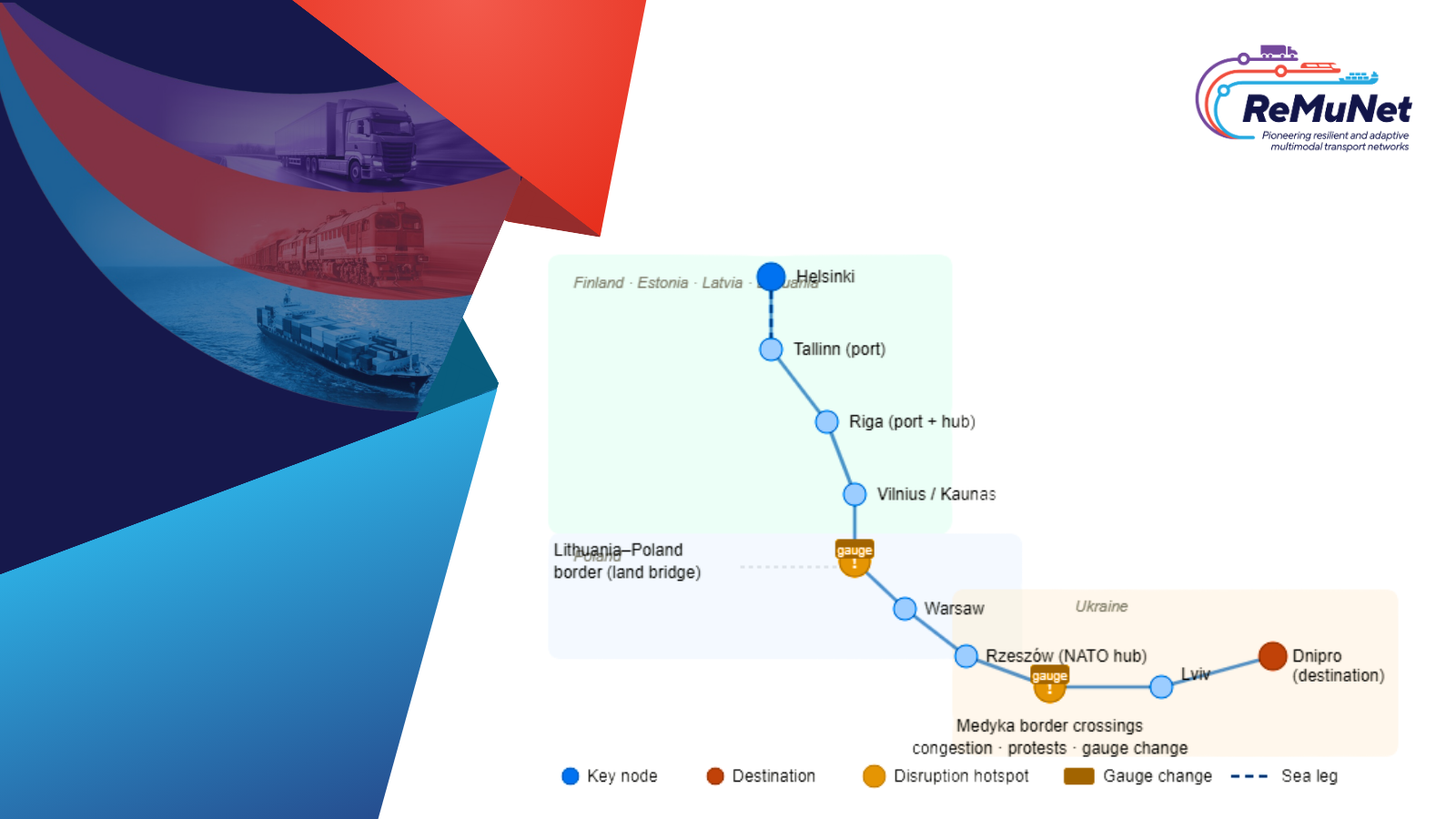
The Baltic–Poland–Ukraine corridor is where European freight resilience research meets real humanitarian need. Aid moving from Finland, Germany, or the Baltic states to Dnipro travels through a chain of ports, intermodal hubs, rail gauge change points, and congested border crossings — all under the shadow of an active conflict zone. This research extends the ReMuNet Disruptions Module to this corridor, producing the first systematic, evidence-based disruption risk assessment of the humanitarian aid route into Ukraine. The findings reveal a route defined by structural fragility at a small number of critical chokepoints — and provide the risk intelligence that the ReMuNet platform needs to generate credible routing recommendations for this corridor.
Context
The delivery of humanitarian aid to Ukraine has mobilised a large and diverse network of actors since February 2022 — NGOs, volunteer associations, commercial logistics providers, and government agencies — all routing freight along corridors that were never designed for this volume or this mix of cargo. The Baltic–Poland–Ukraine axis has become one of the most important of these corridors, carrying rescue vehicles, medical supplies, vaccines, food, and equipment from northern and western Europe into a country where airspace is closed and most seaports are blocked or occupied.
For a disruption risk assessment tool, this corridor is about as demanding as it gets. It combines structural vulnerabilities unique to the region (two rail gauge incompatibility points, a geographically constrained land bridge between hostile territories) with dynamic disruption sources (conflict-driven infrastructure damage, politically motivated border blockades, conscription-related staffing shortages) and sparse historical event data for some segments. Demonstrating that the ReMuNet Disruptions Module can produce meaningful risk outputs under these conditions was both a research challenge and a platform credibility test.
The work draws on empirical shipment data provided by the Danish Red Cross — a ReMuNet partner — covering aid deliveries from March 2022 to April 2023, supplemented by expert interviews with humanitarian logistics operators and systematic desk-based corridor mapping.
About Hanken School of Economics
Hanken School of Economics led Work Package 5 of ReMuNet, which developed and tested the project’s social pilot use cases with a focus on humanitarian logistics. The HUMLOG Institute at Hanken is one of Europe’s leading centres for humanitarian supply chain research, with extensive experience in conflict-affected logistics environments. ER16 combines Hanken’s humanitarian logistics expertise with the disruption risk assessment capabilities developed in Work Package 1 (ER15), representing an applied extension of the core DEM methodology to an extreme operational context.
Solution
The corridor assessment was conducted in three stages:
Infrastructure mapping. A comprehensive inventory of transport nodes along the corridor — 14 ports across Estonia, Latvia, Lithuania, and Poland; 8 airports with cargo facilities; 12 major rail and road hubs; and 10 key border crossings — was compiled through desk-based research using EU TEN-T documentation, national transport authority publications, and geospatial tools, then validated through expert interviews with humanitarian logistics operators and regional transport professionals. Operational details captured include gauge specifications, handling capacities, seasonal accessibility constraints, and current operational status.
Dataset extension and new disruption category. The DEM dataset was extended to the Baltic–Ukraine corridor for the period 2022–2025, using ACLED conflict monitoring data, OCHA humanitarian access reports, ACAP event records, and logistics trade press as primary sources. A fifth disruption category — conflict and border disruption — was defined covering agricultural protest blockades, conscription-related staffing shortages, security-based access restrictions, and infrastructure damage from military activity.
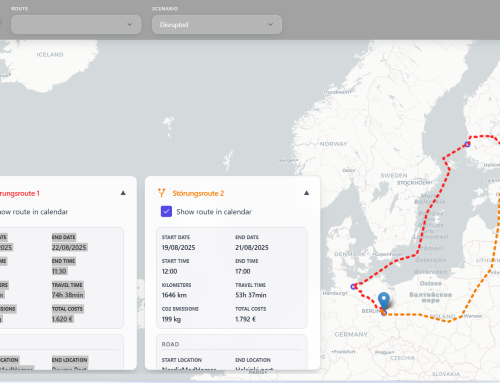
Risk scoring and pilot scenarios. The Poisson risk calculator was applied to generate seasonally-adjusted risk profiles for key corridor nodes. Two concrete pilot scenarios — Finland to Dnipro (rescue vehicles, sea and road) and Germany to Dnipro (temperature-sensitive vaccines, rail) — were developed using Danish Red Cross shipment data to ground the assessment in real humanitarian operational parameters. Each scenario includes a primary routing option and a defined rerouting response triggered by disruption at the highest-risk nodes.
Outcomes and next steps
- Corridor-specific risk profiles for the Baltic–Ukraine axis are integrated into the ReMuNet platform demo for the humanitarian pilot scenarios.
- The conflict and border disruption category, and the data collection methodology for sparse conflict-corridor environments, are transferable to other geopolitically exposed European corridors.
- The findings highlight the Lithuania–Poland land bridge and Medyka border crossings as the highest-risk structural points on the corridor — inputs directly relevant to EU military mobility and humanitarian logistics planning.
- Future directions: integration with real-time ACLED and OCHA data feeds for dynamic risk updating; extension of the humanitarian corridor assessment to additional origin–destination pairs.
Contact
Name Position Organisation Email Ketki Kulkarni Postdoctoral Researcher Hanken School of Economics [email protected]
Assessing Risk on Europe’s Most Challenging Humanitarian Corridor
Analysing disruption vulnerabilities across the Baltic–Poland–Ukraine corridor to support more resilient humanitarian freight transport.
Turning Humanitarian Logistics Data into Resilience Intelligence
Extending the ReMuNet Disruptions Module with conflict-related and border disruption data to improve risk-aware routing decisions.
Supporting Reliable Aid Deliveries Through Smarter Routing
Developing corridor-specific risk profiles and pilot scenarios to strengthen the planning of humanitarian transport operations into Ukraine.
 Funded by the European Union under GA number 101104072. Views and opinions expressed are however those of the author(s) only and do not necessarily reflect those of the European Union or the European Climate, Infrastructure and Environment Executive Agency (CINEA). Neither the European Union nor the granting authority can be held responsible for them.