

What humanitarian logistics teaches us about designing better routing platforms for everyone
Platform design · Humanitarian logistics · Functionality mapping | Work Package 5
Introduction
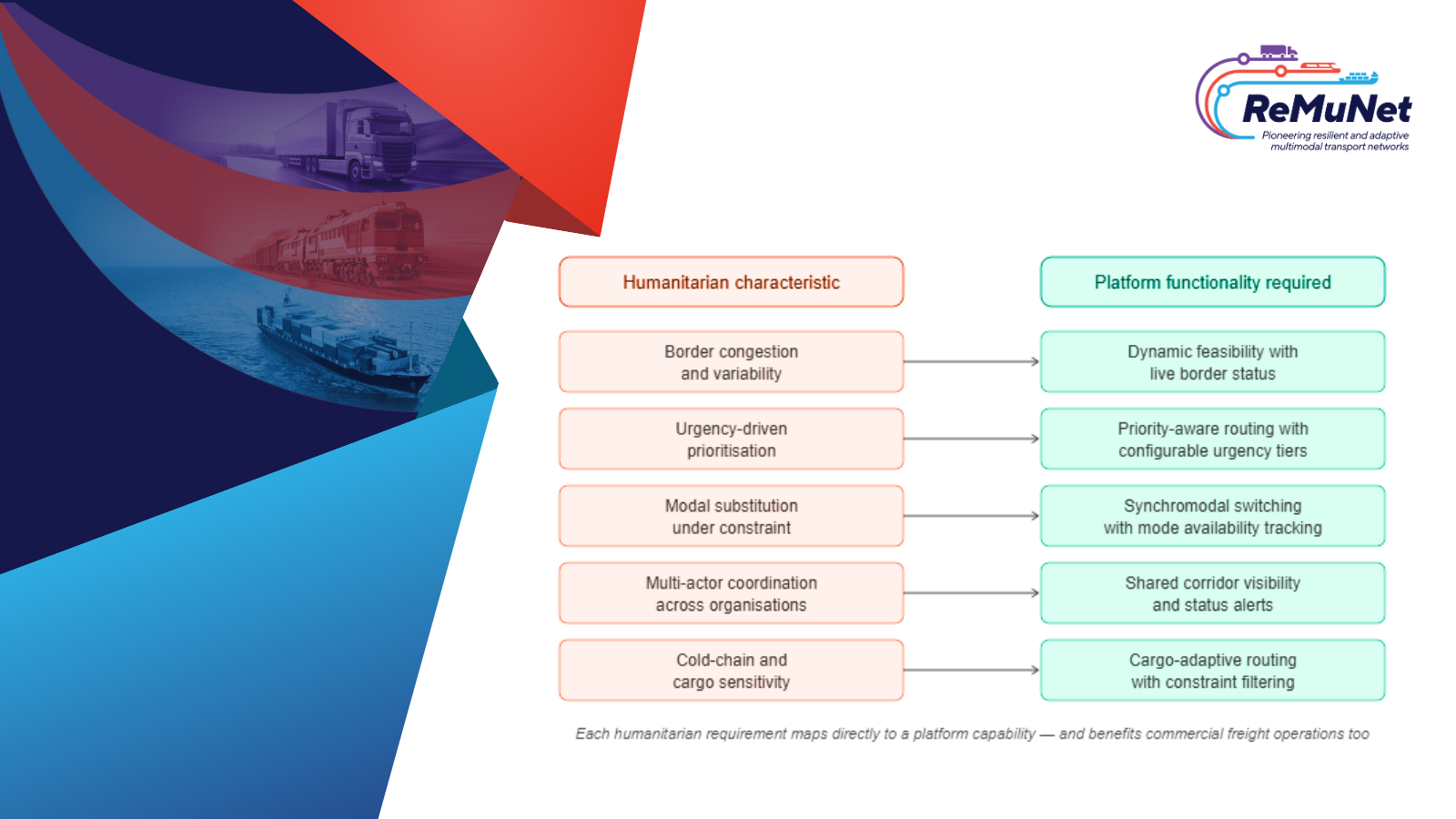
Designing a routing platform for humanitarian logistics in a conflict zone forces you to confront every weakness that normal commercial freight conditions allow you to ignore. Border crossings that change status within hours. Shipments that cannot be late by even a day. Coordination across dozens of organisations with different systems and priorities. When you build a platform that handles these conditions, you end up with a platform that handles commercial disruptions — weather, strikes, border delays, modal failures — much more effectively too. ER18 documents this insight systematically, mapping what humanitarian logistics requires onto specific platform functionality, and showing how addressing those requirements benefits commercial multimodal freight operations as well.
Context
The ReMuNet platform was designed primarily for commercial multimodal freight routing under disruption. Its core capabilities — disruption detection, synchromodal rerouting, corridor assessment, and capacity optimisation — address needs that commercial operators and humanitarian organisations share. But humanitarian logistics imposes additional and distinctive requirements that commercial design does not automatically address: hard time constraints differentiated by cargo urgency, coordination across heterogeneous actor networks spanning NGOs, commercial forwarders, government agencies, and infrastructure operators, and routing decisions that must account explicitly for security conditions and conflict-zone proximity.
Understanding how these requirements translate into platform functionality is valuable in both directions. For humanitarian logistics practitioners, it clarifies what a commercial-origin platform can and cannot offer, and what adaptations would extend its utility. For platform developers, it reveals capability gaps that — once addressed for humanitarian purposes — strengthen performance under any high-pressure, disrupted commercial scenario. This two-directional value is the central argument of ER18: crisis-informed design is a resilience upgrade for everyone.
The mapping was developed through empirical analysis of the Ukraine humanitarian aid corridor, drawing on qualitative findings from 20 expert interviews with humanitarian logistics professionals, corridor operators, and transport planners, combined with quantitative insights from Danish Red Cross shipment data.
About Hanken School of Economics
Hanken School of Economics led Work Package 5 of ReMuNet. The HUMLOG Institute at Hanken has decades of experience working with humanitarian organisations on supply chain design and digital tools for crisis response — making Hanken uniquely positioned to bridge the gap between commercial platform development and humanitarian operational realities. ER18 draws directly on WP5 empirical findings and Hanken’s broader research tradition in humanitarian supply chain management. The mapping framework is openly published as part of Deliverable D5.2 and is available for use by platform developers and humanitarian logistics organisations
Challenge addressed
- Capability gap with no systematic basis: commercial routing platforms had not been evaluated against humanitarian logistics requirements in a structured way, leaving both platform developers and humanitarian practitioners without a reliable basis for assessing fit or identifying necessary adaptations.
- Dual-use design potential underexplored: the insight that crisis requirements often strengthen commercial platform capabilities was recognised anecdotally but not documented. Without systematic evidence, platform investment decisions could not be made on this basis.
- Multi-actor coordination complexity: humanitarian logistics involves coordination across actors with fundamentally different planning horizons, information systems, and prioritisation criteria. Platforms designed for single-operator use do not naturally support this heterogeneity.
- Traceability and accountability gap: donors and regulatory authorities require shipment traceability that is often manual or paper-based in current humanitarian operations. The gap between what platforms provide and what humanitarian accountability requires needed to be mapped before it could be addressed.
- Security and conflict-one routing: humanitarian operations require routing decisions that explicitly account for curfews, restricted zones, conflict proximity, and safe corridor availability — functionalities absent from most commercial routing platforms but increasingly relevant as European freight corridors face elevated geopolitical risk.
Solution
ER18 delivers a structured mapping of humanitarian logistics operational characteristics to platform functionality requirements, organised across three functional categories:
Network constraint handling. Humanitarian corridors feature border crossings that can change status within hours, intermodal terminals acting as critical bottlenecks, and corridor accessibility shifting dynamically with security conditions. These translate into platform requirements for dynamic feasibility evaluation with live border status integration, bottleneck-aware routing that accounts for node capacity constraints, and continuous alternative corridor generation rather than static routing tables.
Operational dynamics support. Restricted air and sea access, high uncertainty in travel times, and coordination across multiple actors across multiple countries translate into requirements for synchromodal routing with real-time mode availability tracking, robustness-aware routing that accounts for time variability rather than deterministic travel times, and shared operational visibility across actor networks — not just optimal routes for a single user.
Decision complexity management. Differentiated urgency levels, concurrent and competing shipments, and cargo types with specific handling requirements (cold chain, oversized, hazardous) translate into requirements for priority-aware routing with configurable urgency tiers, concurrent shipment optimisation under competing constraints, and cargo-adaptive routing based on shipment characteristics.
In addition to the functional mapping, ER18 proposes specific platform alert and coordination features with documented humanitarian use cases — safety alerts for conflict zone proximity and safe corridor updates, operational alerts for border crossing times and bottlenecks, and coordination alerts for inter-agency shipment status sharing — and demonstrates how equivalent features would benefit commercial operators managing freight through disrupted corridors.
Outcomes and next steps
- The mapping has been incorporated into the ReMuNet platform development roadmap, informing capability priorities for the humanitarian pilot demonstration.
- The mapping framework is openly published in D5.2 and available for platform developers and humanitarian logistics organisations to use and adapt.
- Future directions: development of open-source humanitarian routing modules as complements to existing humanitarian coordination platforms; exploration of interoperability between ReMuNet and humanitarian logistics cluster tools; further research on AI-assisted dynamic urgency management.
Contact
Name Position Organisation Email Ketki Kulkarni Postdoctoral Researcher Hanken School of Economics [email protected]
What Humanitarian Logistics Reveals About Better Routing Platforms
Mapping how crisis-driven logistics requirements translate into concrete platform functionalities that improve routing performance across all freight contexts.
Designing Platforms That Work Under Extreme Operational Pressure
Identifying how conflict-zone constraints, urgency differentiation, and multi-actor coordination strengthen synchromodal routing system design.
From Humanitarian Needs to Commercial Platform Innovation
Showing how features developed for humanitarian logistics can directly enhance resilience, traceability, and adaptability in commercial freight systems.
 Funded by the European Union under GA number 101104072. Views and opinions expressed are however those of the author(s) only and do not necessarily reflect those of the European Union or the European Climate, Infrastructure and Environment Executive Agency (CINEA). Neither the European Union nor the granting authority can be held responsible for them.