

A methodology for stress-testing routing platforms before a real crisis hits
Platform evaluation · Stress-testing · Synchromodal routing | Work Package 5
Introduction
A routing platform that performs well under normal freight conditions may fail completely when a real disruption hits. Testing platforms only in routine scenarios is like testing a bridge only with light traffic — it tells you very little about what happens under load. ER17 addresses this gap with a structured, replicable five-component methodology for stress-testing synchromodal routing platforms using humanitarian crisis scenarios as extreme-environment test cases. Applied to the Ukraine humanitarian aid corridor, it produces a realistic, operationally grounded dataset that exposes platform capabilities and limitations in ways that routine freight scenarios simply cannot.
Context
Synchromodal routing platforms — systems that dynamically select and switch between transport modes to maintain freight flows under disruption — are a promising tool for building more resilient European freight networks. The ReMuNet platform is one such system, and validating its disruption-handling logic is a core project objective. But a persistent problem exists in how such platforms are evaluated: almost all validation exercises use routine or synthetic freight datasets, designed for normal operating conditions. The compound, fast-moving, heterogeneous disruption scenarios that platforms will actually face in operation are largely absent from validation practice.
Humanitarian logistics in conflict settings provides a natural extreme-environment laboratory. The delivery of aid to Ukraine involves simultaneous disruptions to infrastructure, border operations, modal availability, and security conditions — exactly the compound disruption scenario that separates genuinely resilient platforms from those that perform well only on paper. Humanitarian logistics also imposes tightly differentiated time-criticality requirements across shipments of very different urgency, stress-testing prioritisation logic as well as routing logic.
ER17 formalises this insight into a replicable methodology. Any platform development team can apply it — to the Ukraine corridor or to any other crisis environment — using the five components as a structured template.
About Hanken School of Economics
Hanken School of Economics led Work Package 5 of ReMuNet, developing the project’s social pilot use cases with a focus on the Ukraine humanitarian corridor. The quantitative and methodological components of the stress-testing methodology — urgency classification, temporal logic design, order dataset construction — were developed by Hanken’s transport research team, drawing on empirical shipment data provided by the Danish Red Cross. The methodology is being prepared for submission to Transportation Research Part E, contributing a replicable evaluation framework to the routing platform development literature.
Challenge addressed
- Platform validation gap: no published methodology existed for stress-testing synchromodal routing platforms using humanitarian or crisis scenarios as structured experimental environments. Platform developers had no systematic template for building extreme-environment test cases.
- Routine-scenario bias: existing validation approaches rely on synthetic datasets that do not reproduce compound disruptions, constrained modal availability, or the dynamic rerouting requirements platforms encounter in real disruption events.
- Heterogeneous service-level requirements: humanitarian logistics involves shipments with fundamentally different time-criticality — temperature-sensitive vaccines needing delivery within 48 hours alongside non-perishable goods that can wait two weeks. A methodology that embeds urgency differentiation as a structural routing constraint, not just a label, was needed.
- Empirical grounding: a stress test built on invented scenarios risks avoiding the awkward edge cases that real operations generate. The methodology needed a principled approach to deriving test datasets from actual humanitarian flows.
- Generalisability: a methodology developed for a specific case needed to be abstracted into a form applicable to other crisis corridors and other platform evaluation contexts.
Solution
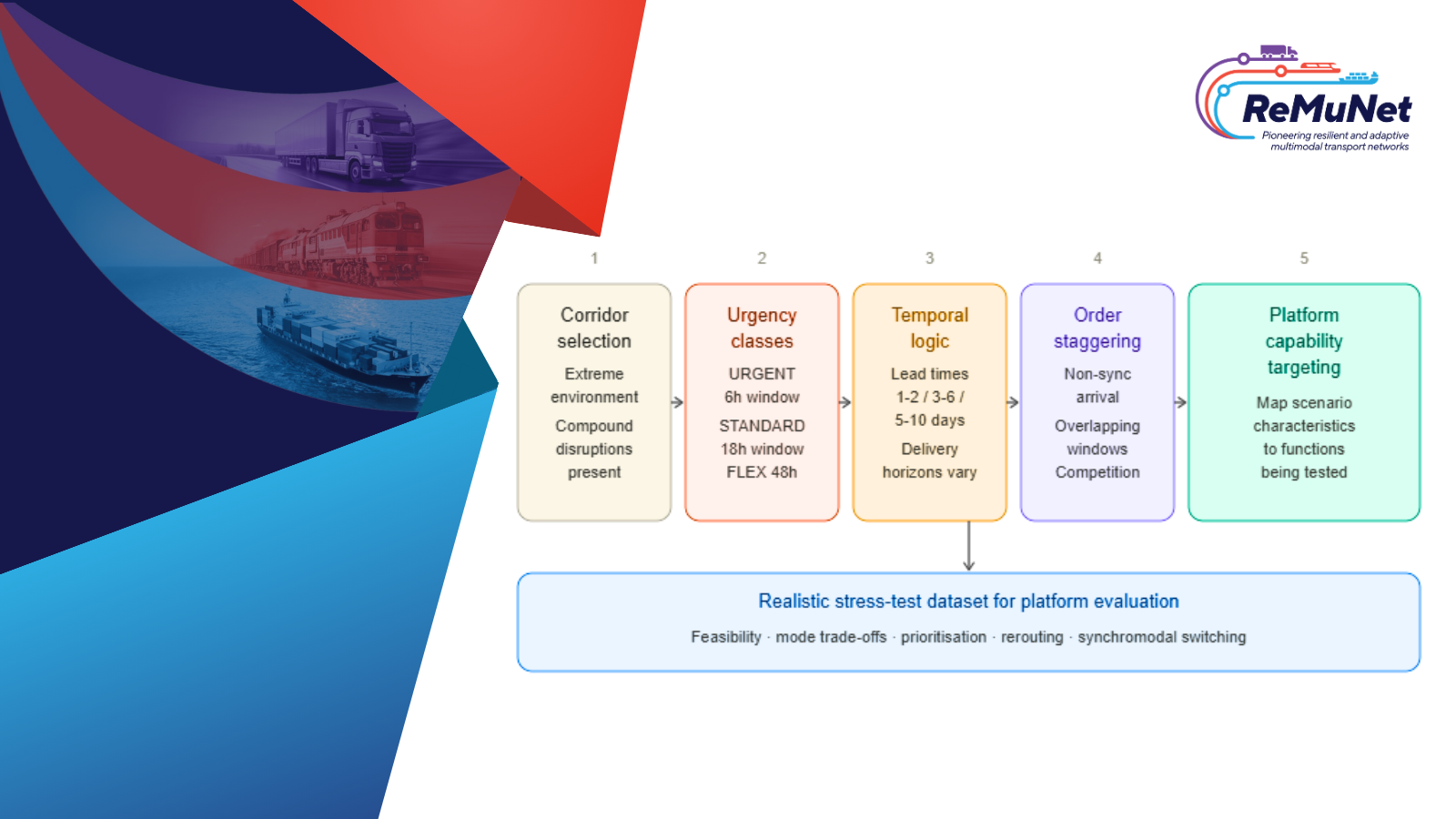
The methodology comprises five components applied sequentially to build the stress-test dataset:
- Corridor selection: a structured approach to identifying crisis corridors that provide genuine stress-testing value, based on criteria of compound disruption co-occurrence, modal constraint diversity, border complexity, and data availability. The Ukraine corridor satisfies all four.
- Urgency classification: a three-tier system (URGENT / STANDARD / FLEX) that converts humanitarian time-criticality into hard routing constraints. URGENT shipments (e.g. vaccines) receive a 6-hour pickup window and a 2–6 day delivery horizon. STANDARD shipments receive an 18-hour window and 4–10 days. FLEX shipments receive a 48-hour window and up to 16 days. Urgency becomes a structural constraint on the routing problem, not a descriptive label.
- Temporal logic design: differentiated order creation lead times by urgency tier (1–2 days for URGENT, 3–6 for STANDARD, 5–10 for FLEX) simulate the reactive planning horizons of humanitarian operations and test the platform’s ability to integrate short-notice urgent orders into an already-planned routing schedule.
- Order staggering: orders are spread across the scenario period with deliberate overlap rather than released as a synchronised batch. This creates competition for modal capacity and tests prioritisation logic — what does the platform do when two urgent shipments compete for the same service?
- Platform capability targeting: each scenario characteristic is mapped explicitly to the platform function it is designed to test — feasibility filtering under tight deadlines, mode selection trade-offs, dynamic rerouting as windows narrow, synchromodal switching under urgency pressure. This ensures evaluable results.
The dataset was derived from Danish Red Cross shipment records (March 2022–April 2023), preserving cargo categories, volumes, and operational parameters from real humanitarian flows while introducing the controlled temporal and prioritisation variables required for platform evaluation.
Outcomes and next steps
- The stress-test dataset is in active use for ReMuNet platform evaluation, enabling testing of feasibility filtering, mode trade-offs, priority handling, dynamic reallocation, and synchromodal switching.
- The five-component methodology is directly transferable to other crisis corridor contexts and other platform development projects.
- Submission to Transportation Research Part E is in preparation, contributing a replicable extreme-environment evaluation framework to the platform development literature.
- Future directions: extension to dynamic urgency (where shipment priority evolves during transit), and publication of open-access anonymised benchmark datasets for use by the broader routing research community.
Contact
Name Position Organisation Email Ketki Kulkarni Postdoctoral Researcher Hanken School of Economics [email protected]
A Methodology to Stress-Test Routing Platforms Before Crisis Hits
Developing a structured, repeatable approach to evaluate synchromodal routing systems under extreme humanitarian and disruption scenarios.
From Humanitarian Operations to Realistic Platform Testing
Using Ukraine corridor logistics as an extreme-environment case to test routing logic, prioritisation, and multimodal adaptability.
Building Robust Evaluation Tools for Synchromodal Routing Systems
Creating scenario-based datasets and testing frameworks that expose platform limits and improve resilience in real-world conditions.
 Funded by the European Union under GA number 101104072. Views and opinions expressed are however those of the author(s) only and do not necessarily reflect those of the European Union or the European Climate, Infrastructure and Environment Executive Agency (CINEA). Neither the European Union nor the granting authority can be held responsible for them.