

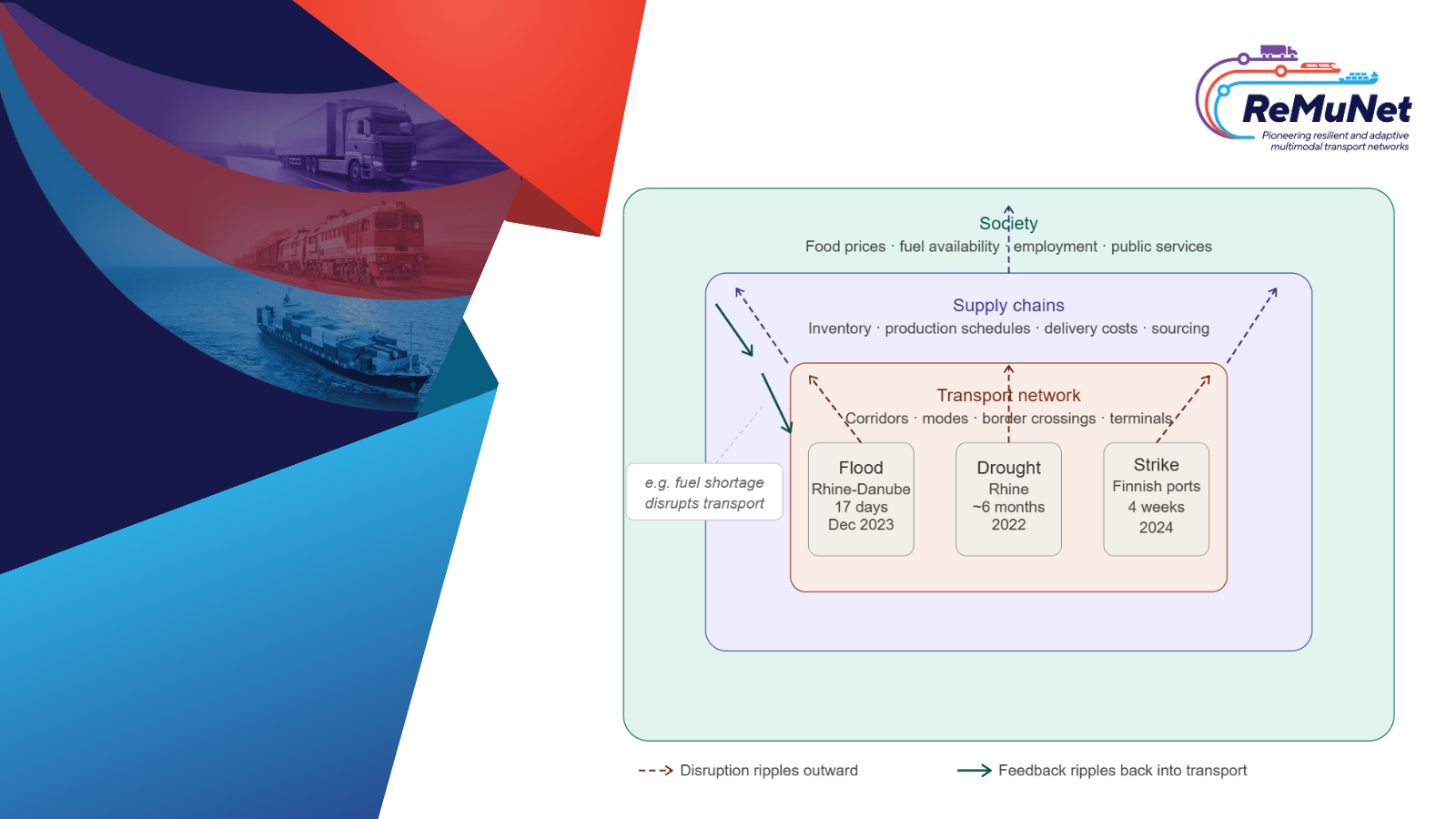
When freight is disrupted, the effects reach far beyond the transport network
Typology · Root cause analysis · Ripple effects · Societal impact | Work Package 1
Introduction
Europe’s freight transport network is more fragile than it looks — and when it breaks, the consequences spread fast. Floods stop barges; barges stopping means coal doesn’t reach power stations; power stations under pressure means energy prices spike for households. This is not a hypothetical chain. It is what happened on the Rhine in the summer of 2022. Hanken’s research within ReMuNet systematically mapped how disruptions travel through transport networks into supply chains and society — including the feedback loops that make them harder to contain. The result is the most evidence-grounded picture yet of how European freight disruptions actually behave, and the conceptual backbone for the ReMuNet platform’s disruption intelligence capabilities.
Context
In recent years, European freight has been shaken by a series of major disruptions: unprecedented Rhine droughts, widespread flooding, a wartime blockade of Ukrainian ports and rail corridors, and a domestic port strike that paralysed almost all of Finland’s foreign trade. Each event triggered debate about transport resilience — but the debates remained largely siloed, focused on individual incidents rather than the patterns connecting them.
The academic literature on supply chain disruptions has grown substantially, but it has largely treated transport networks as background infrastructure rather than active sources of disruption in their own right. This left a gap: no evidence-based framework existed for understanding how disruptions originating in freight transport networks propagate through supply chains into society, how they interact with each other, and what drives them at the root. For a platform like ReMuNet — which claims to improve multimodal freight resilience — filling this gap was essential. Disruption-aware routing requires disruption intelligence, and disruption intelligence requires understanding not just what happened, but why and how it spread.
The policy relevance is significant. Europe’s decarbonisation goals depend heavily on shifting freight from road to rail, inland waterways, and short-sea shipping. All three of these modes are more vulnerable to certain disruption types than road transport. Understanding disruption dynamics is therefore inseparable from sustainable freight planning.
About Hanken School of Economics
Hanken School of Economics is a Finnish research university with internationally recognised expertise in logistics, supply chain management, and humanitarian logistics, centred on the HUMLOG Institute. Within ReMuNet, Hanken led Work Package 1 — the foundational research on disruption characterisation, root causes, and societal impact. This involved coordinating data collection across multiple European countries, running focus groups with over 60 freight transport practitioners, conducting 17 expert interviews, and producing the typology and analytical frameworks that underpin the platform’s disruption intelligence layer. Hanken also led Work Package 5, developing the humanitarian aid pilot use case.
Challenge addressed
Three interconnected challenges shaped the work:
- Fragmented understanding: existing research treated disruption types (floods, strikes, geopolitical crises) as separate phenomena, each studied in isolation. There was no cross-cutting framework for comparing how different disruption types behave, propagate, and interact — making it impossible to build a platform that handles the full range of disruptions it will encounter in practice.
- Supply-chain-centric blind spot: the ripple effects literature focused almost exclusively on how disruptions spread within supply chains — from suppliers to manufacturers to customers. The transport network layer, where many disruptions originate, was largely absent. This meant platforms built on existing frameworks would miss the systemic nature of transport disruptions.
- Root causes ignored in favour of response: interviews with 17 transport operators and logistics managers across Europe found that 100% of respondents prioritised immediate disruption response over root cause analysis. While understandable, this approach leaves underlying causes unaddressed — and all five disruption cases examined carry high recurrence risk precisely because their root causes are worsening, not improving.
Solution
Hanken conducted a three-stage qualitative research programme producing three interconnected outputs:
Typology of disruptive events (D1.3). A practitioner-validated classification of ten disruption cause categories — from natural hazards and infrastructure failure to geopolitical conflict and labour disputes — characterised across dimensions of duration, geographic extent, predictability, recurrence probability, and criticality. Developed through two rounds of focus group discussions involving 67 European freight transport experts, the typology provides the shared vocabulary for all ReMuNet platform components.
Root cause analysis (D1.4). Using the 5-Why method applied to five recent European transport disruptions — Rhine droughts, Slovenian floods, Gotthard tunnel closure, Swedish E6 landslide, and Panama Canal congestion — the analysis traced each event back to four ‘mega root causes’: climate change and biodiversity loss; infrastructure underinvestment and maintenance failures; geopolitical conflict; and shifts in human behaviour and economic structures. A key finding: the immediate trigger of a disruption is almost never its root cause, and without addressing underlying causes, recurrence risk remains high.
Ripple effects and societal impact analysis (D1.5). Analysing four disruption events in depth — Rhine–Danube floods 2023, Rhine droughts 2022, Finnish port strikes 2024, and the Ukraine war — using focus groups, 17 expert interviews, and 100 media articles, the study developed a three-level ripple effects framework. Three linkage types were operationalised: direct impacts (clearly attributable consequences at the transport level), interacting effects (disruptions compounding existing vulnerabilities across supply chains), and co-occurring effects (societal consequences occurring in the same timeframe). Critically, the research demonstrated that ripple effects are bidirectional: supply chain and societal pressures feed back into transport operations, not just the reverse. The Rhine drought was made more severe by the energy crisis triggered by the Ukraine war. Fuel shortages during the Finnish port strikes threatened airport operations with no direct connection to the original labour dispute.
Outcomes and next steps
- The typology and root cause framework are adopted as the conceptual backbone of the ReMuNet platform’s disruption intelligence layer, enabling consistent classification of disruption signals across all platform components.
- The ripple effects and intersectionality findings are submitted for publication in the International Journal of Physical Distribution and Logistics Management.
- The framework is directly applicable to EU transport policy on climate adaptation, critical infrastructure protection, and multimodal resilience planning.
- Future directions include extension to emerging disruption types (cyber threats, hybrid infrastructure attacks) and integration with real-time conflict and weather monitoring feeds.
Contact
Name Position Organisation Email Ketki Kulkarni Postdoctoral Researcher Hanken School of Economics [email protected]
Understanding Freight Disruptions Beyond Transport
Mapping how disruptions spread across transport networks, supply chains, and society to reveal their wider economic and societal impacts.
Identifying Root Causes of Transport Vulnerabilities
Developing a disruption typology and root-cause framework to better understand why freight disruptions occur and how they can be anticipated.
Building Intelligence for Resilient Multimodal Transport
Providing the conceptual foundation for ReMuNet’s disruption intelligence capabilities to support more resilient and adaptive freight planning.
 Funded by the European Union under GA number 101104072. Views and opinions expressed are however those of the author(s) only and do not necessarily reflect those of the European Union or the European Climate, Infrastructure and Environment Executive Agency (CINEA). Neither the European Union nor the granting authority can be held responsible for them.