

Piloting Event-Based synchromodal Relay Transport for Resilient European Freight Corridors
Synchromodal pilots · Corridor validation · Multimodal resilience | Work Package 5
Introduction
Freight transport corridors are increasingly affected by disruptions such as infrastructure bottlenecks, capacity shortages, climate-related events, geopolitical instability and changing operational requirements. These disruptions create uncertainty for logistics operators and highlight the need for more flexible, multimodal and resilient transport solutions. Within ReMuNet Work Package 5, the focus is on piloting event-based synchromodal relay transport in operational contexts.
Vediafi contributes by supporting the practical validation of corridor-based multimodal transport concepts, stakeholder needs and implementation conditions in the Nordic and Baltic Sea region. The result is important because it connects the technical development of ReMuNet with transport operations, helping to demonstrate how multimodal alternatives, disruption information and collaborative decision-making can improve resilience, sustainability and operational reliability in European freight corridors. North Sea Baltic corridor (NBC) is very challenging corridor at the moment, since due the Geopolitical situation NCB corridor has changed from multi direction environment to North-South corridor, which is heavily dominated by road transport.
Context
This work was developed in the context of European multimodal freight transport, where logistics chains often depend on the smooth coordination of road, rail, maritime and terminal operations. In practice, however, the use of multimodal alternatives is limited by fragmented information, lack of real-time visibility, different operational practices between transport modes and uncertainty about available capacity or suitable transshipment points. These limitations become more visible during disruptions, when logistics operators need to react quickly and evaluate alternative routing options.
WP5 addresses this challenge through pilots and use cases designed for in the North Sea–Baltic, humanitarian logistics and Rhine–Danube corridors. The purpose is to test and validate the ReMuNet concepts, platform approach, routing logic and simulation results. The pilots are intended to involve relevant stakeholders and different transport modes, using simulated transport data and operational experience as reference material for further analysis.
This matters within the ReMuNet vision because the project aims to support faster and more adaptive responses to disruptive events in multimodal freight corridors. By testing the approach through practical use cases, WP5 helps move ReMuNet from theoretical modelling and technical development towards implementation, validation and future scalability.
The ReMuNet project develops a proof-of-concept solution, which has been validated in WP5. The validation has shown the complexity and challenges of multimodal logistics. To get accurate and real-time support from the platform a close engagement from several stakeholders is needed (e.g. shippers, transport service providers, IT service providers, …)
About Vediafi
Vediafi is a Finnish SME company specialised on software services for transport and logistics industry. Vedia excellence is built on data sharing, multi-stakeholder platforms and regulatory technologies. Vedia sees that in future such a disruptive event platforms will support and enhance logistics operations and will be connected to B2B and B2A data sharing solutions, such as eFTI regulation.
In the ReMuNet project, Vedia coordinates WP5 pilots and is hence focusing on technical outcomes of the project.
Challenge addressed
The specific challenge addressed was the gap between advanced multimodal transport concepts and their practical application in logistics operations. ReMuNet develops models, algorithms, platform components and disruption-response methods, but these need to be tested in realistic operational environments before they can create value for transport actors. WP5 addresses this by preparing and validating pilot activities in selected European corridors.
A key challenge is that disruptions rarely affect only one actor or one transport mode. They may require coordinated responses between shippers, carriers, terminal operators, infrastructure managers, technology providers, public-sector actors and humanitarian organisations. During disruptions, stakeholders need reliable information about alternative routes, available capacity, suitable transshipment points, timing, costs, emissions and operational risks. If this information is incomplete or difficult to use, decision-making becomes slower and less resilient.
Interpretting these issues from a practical corridor and stakeholder perspective. The work focused on making the pilot context understandable, identifying relevant operational needs, and supporting the link between ReMuNet’s technical development and real-world implementation conditions.
Solution
The result developed in WP5 can be described as a pilot validation and corridor implementation framework for event-based synchromodal relay transport. The purpose of this framework is to support the practical testing of ReMuNet concepts in real transport corridors and to assess how disruption-aware multimodal transport planning can be applied in operational environments.
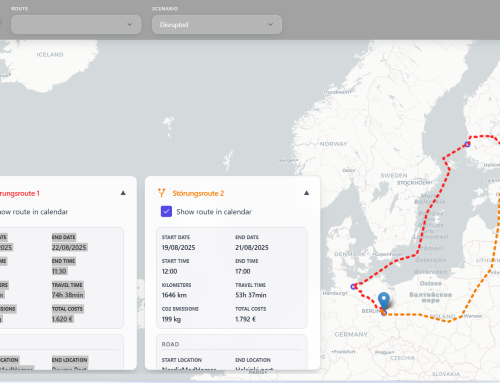
The framework builds on the ReMuNet platform concept, routing logic, simulation work and disruption-response methods developed in earlier work packages. In WP5, these elements are tested through pilot activities and use cases, which are simulated based on real world shipments and transportations. The Proof of Concept focuses on validating synchromodal relay transport in the face of disruptive events. This includes preparing pilot shipments, engaging relevant stakeholders, collecting real transport data and recording logistics events during the transport process.
A central part of the WP5 approach is the use of use cases. The social use case focuses on auxiliary supplies to Ukraine. It examines how multimodal transport networks can support humanitarian logistics through several routes, multiple European countries, at least two transport modes and cooperation between humanitarian organisations. This use case also considers the need to keep alternative routes available without risking the actual deliveries.
WP5 also includes roadmaps and strategies for scaling ReMuNet to further transport corridors, covering public and private development paths, business analysis, governance, political implications and legislative aspects. Special attention is give to disruptive data space and how it could improve resilience of logistics in future.
Outcomes and next steps
The key outcome of WP5 is the validation of ReMuNet concepts through pilot activities and use cases. The work supports a better understanding of how event-based synchromodal relay transport can improve resilience, sustainability and decision-making in European freight corridors. Expected achievements include improved visibility of multimodal alternatives, stronger stakeholder cooperation, use of real transport data, and practical lessons for applying ReMuNet in operational environments.
The next steps are to complete the pilot validation, analyse results from the Proof of Concept and use cases, and translate the findings into public and private roadmaps for scalability. Future development should focus on wider corridor implementation, stronger integration with logistics systems and processes, continued stakeholder engagement and opportunities to apply the ReMuNet approach in real world use cases.
Contact
Name Position Organisation Email Juho Lehti Project manager Vediafi [email protected]
Humanitarian Logistics as a Blueprint for Resilient Routing Platforms
Maps humanitarian operational requirements onto platform functionality to improve resilience, coordination, and decision-making in disrupted multimodal freight systems.
From Crisis Constraints to Network-Aware Routing Intelligence
Transforms volatile border conditions, security constraints, and multi-actor coordination needs into dynamic routing capabilities such as live feasibility checks and bottleneck-aware planning.
Dual-Use Design for Humanitarian and Commercial Freight Systems
Shows how capabilities developed for crisis logistics strengthen commercial routing platforms by improving traceability, adaptability, and disruption-aware decision support.
 Funded by the European Union under GA number 101104072. Views and opinions expressed are however those of the author(s) only and do not necessarily reflect those of the European Union or the European Climate, Infrastructure and Environment Executive Agency (CINEA). Neither the European Union nor the granting authority can be held responsible for them.